SELECTED WORK / 01 / ALPHA DEMO
ClinicPulse.
A field report should survive weak signal and uncertain retries.

CLINICPULSE / CONCEPT ILLUSTRATION
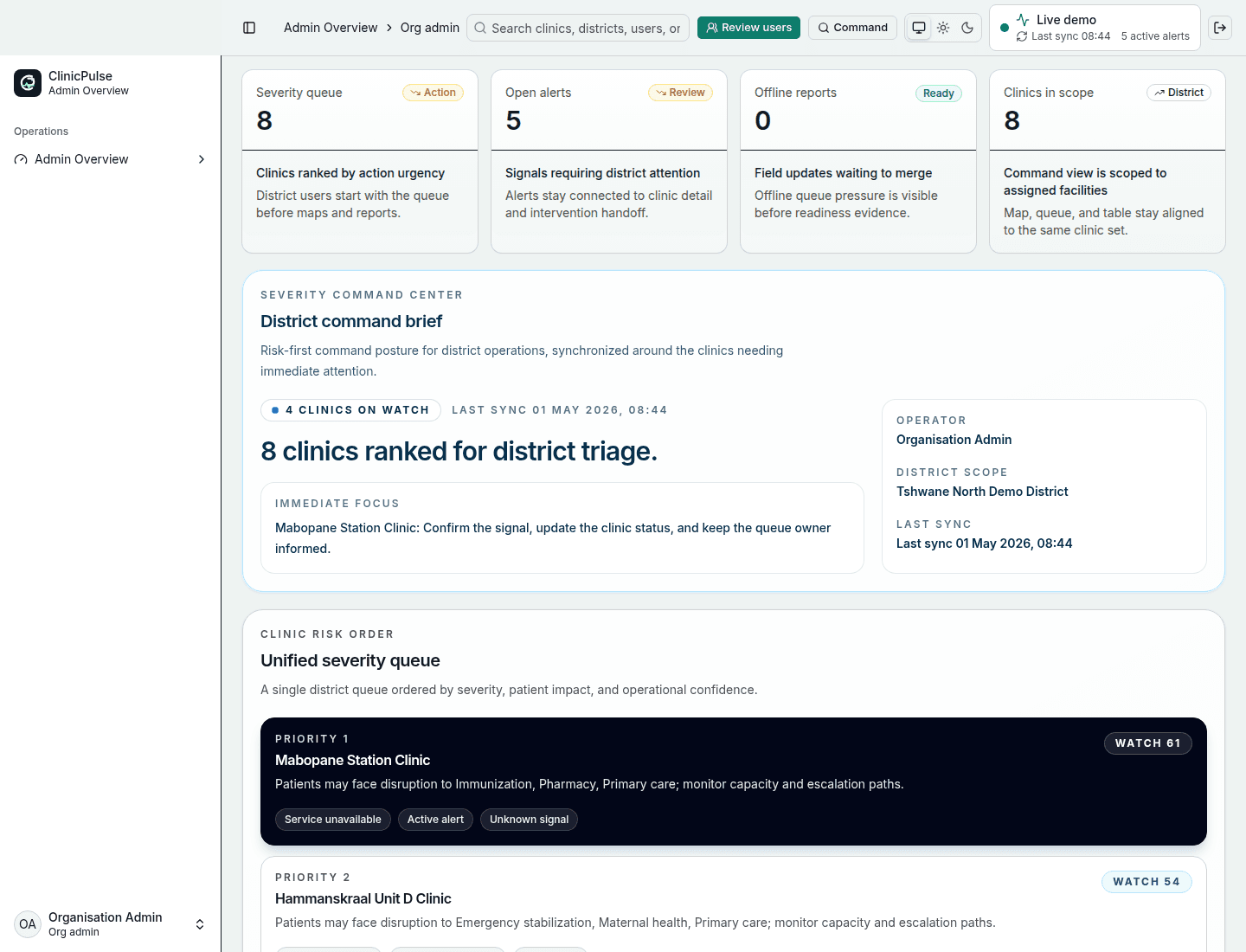
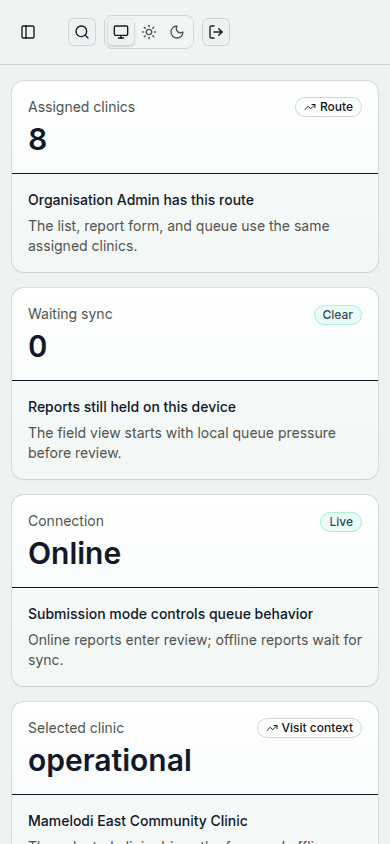
Field reporting that can recover.
A self-directed clinic-operations demo connecting field reporting, district review, public discovery, and audit context.
01 / THE PROBLEM
What made this hard
A clinic status can change before a field reporter has reliable connectivity. A delayed acknowledgement can make a submitted report look unsent, and a retry can create a duplicate or hide a changed payload.
02 / ROLE & CONSTRAINTS
What I owned
Self-directed product engineering across the Next.js reporting interface, Go synchronization service, and PostgreSQL records.
Offline drafts must persist, retries need a stable client identity, district review needs the source and sync outcome, and role boundaries must hold on the server.
03 / DECISIONS
How the boundary works
- 01
Persist field reports in IndexedDB until synchronization can complete.
- 02
Compare client report IDs and payloads: equal submissions are duplicates, while changed submissions return a conflict for review.
- 03
Record sync attempts and re-read after a uniqueness race so the response describes the surviving report.
04 / FAILURE CASE
The case worth testing
When a client retries after an uncertain response, the same ID and payload is safe to recognize as a duplicate. Reusing the ID with different content returns a conflict instead of silently replacing the report.
05 / PROOF & LIMITS
What the evidence supports
Go regressions cover duplicates, conflicts, uniqueness races, timestamp precision, per-item validation, and attempt-record failure. Public CI for the referenced revision passed on 13 August 2026.
Alpha, self-directed demo with seeded scenario data. The modeled routing and time-saved figures are not observed clinic deployments or patient outcomes.
TOOLS & TECHNOLOGIES